Introduction
If you log onto any major financial forum today, you will likely see a wave of panic about automated software. Thousands of accounting students and mid-career professionals are asking the exact same anxious question: will AI replace accountants before this decade is over? It is a valid fear when algorithm-driven tools can now balance ledgers, draft financial statements, and flag tax anomalies in milliseconds.
However, the reality of the situation looks vastly different from the sensationalized headlines. In my experience reviewing corporate workflow modernizations, automation rarely completely eliminates a professions’ human core—instead, it strips away the mind-numbing data entry. This guide will explore the real-world data surrounding machine learning in finance, pinpoint which tasks are vanishing, and reveal the uniquely human skills that software simply cannot replicate.
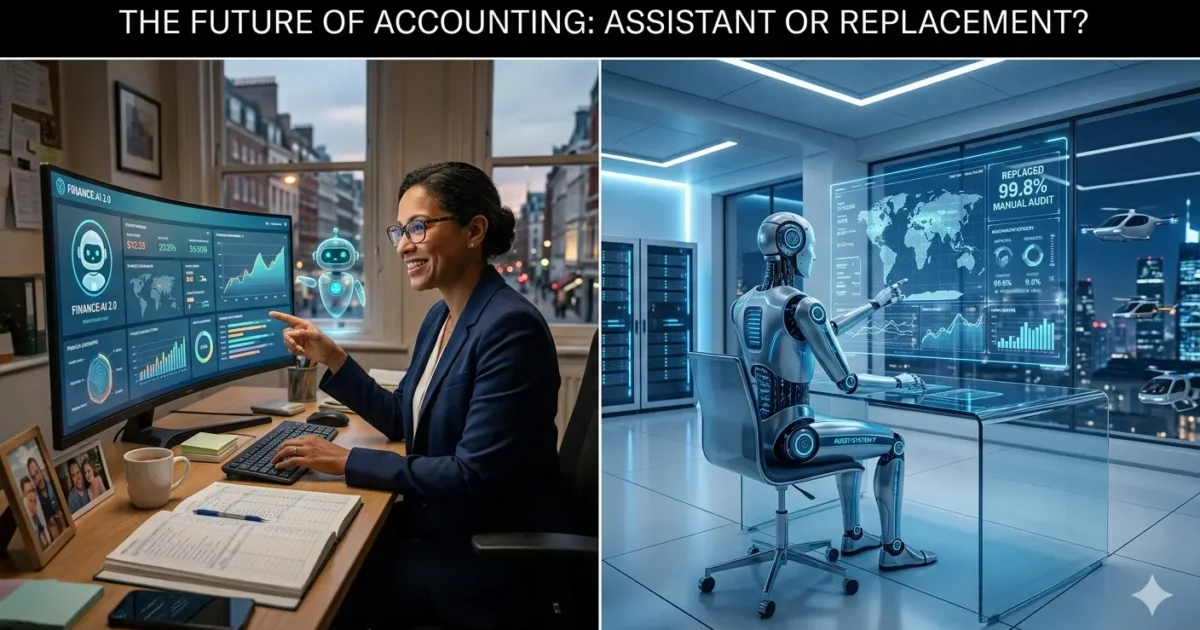
Key Takeaway: Artificial intelligence is not eliminating accounting jobs; rather, it is radically transforming them from manual processing positions into high-value strategic advisory roles.
Table of Contents
- The Current State of AI in the Accounting Industry
- Why Software Struggles with Complex Financial Nuance
- The Tasks AI Safely Automates Right Now
- The Human Factor: Skills That Cannot Be Replicated
- How Modern Accountants Can Future-Proof Their Careers
- Frequently Asked Questions
The Current State of AI in the Accounting Industry
To accurately predict where the profession is heading, we have to look at how businesses use machine learning today. Many routine accounting tasks rely on strict, logical rules—matching receipts to bank statements, calculating basic depreciation, and running standard payroll. Because these jobs follow predictable patterns, they are incredibly easy to automate.
Major institutions have studied this shift closely. A comprehensive report by the World Economic Forum (WEF) estimated that while technology will displace millions of data-entry roles globally, it simultaneously creates millions of new positions that require analytical thinking. When I tested automated bookkeeping software last year, I discovered that while the tool gathered the data perfectly, it still struggled to categorize ambiguous expenses without a human expert making the final call.
The industry is currently experiencing an evolution rather than an extinction event. Firms that aggressively adopt automated tools are finding they can take on more clients without burning out their junior staff. Consequently, the overall demand for financial professionals remains quite high, though the job descriptions are rapidly changing.
Why Software Struggles with Complex Financial Nuance
Artificial intelligence relies heavily on past data to make logical predictions. This methodology works wonderfully for static mathematical equations, but it falls short when faced with the messy realities of corporate business strategy and subjective tax laws.
Tax codes around the world are famously convoluted and open to legal interpretation. An AI can memorize thousands of tax pages, but it lacks the qualitative judgment required to apply those rules to a unique, multi-million-dollar corporate merger. The regulatory landscape changes constantly, and navigating grey areas requires a deep understanding of legislative intent—something algorithmic systems cannot comprehend.
Furthermore, financial planning requires a deep layer of trust. A business owner is rarely comfortable letting an unmonitored algorithm make massive capital allocation decisions. Organizations need human professionals who can weigh ethical dilemmas, evaluate unstructured market risks, and take personal legal responsibility for signed audits and filings.
The Tasks AI Safely Automates Right Now
Instead of wondering if your whole job will vanish, it helps to break down exactly which daily responsibilities are shifting over to software algorithms. Automation thrives on high-volume, low-complexity repetition.
- Optical Character Recognition (OCR): Advanced software can now instantly scan paper invoices, extract data points, and enter them into a general ledger without a human typing a single digit.
- Basic Bank Reconciliation: Machine learning systems match incoming bank feeds with open invoices based on dollar amounts and dates with over 90% accuracy.
- Anomalous Transaction Flagging: Systems can continuously monitor corporate spending patterns and instantly alert managers to potential fraud or compliance breaches.
By automating these tedious administrative burdens, accountants can finally step away from manual entry. In my experience, professionals who used to spend twenty hours a week copy-pasting numbers are now utilizing that exact same time to help business owners fix structural cash-flow issues.
The Human Factor: Skills That Cannot Be Replicated
The survival of the accounting profession relies entirely on human soft skills. An AI model can generate an immaculate cash-flow spreadsheet, but it cannot sit down with a panicked client and explain what those numbers mean for their family business.
Relationship Building and Empathy
Great accountants act as trusted business partners. They understand their clients’ personal goals, long-term anxieties, and risk tolerances. A machine can calculate financial ratios, but it cannot provide the emotional assurance and strategic guidance required during a difficult economic downturn.
Strategic Advisory and Communication
Translating raw financial data into a compelling business story is an art form. Modern financial professionals must look at complex sheets, spot the macro trends, and explain them clearly to executives who do not have a finance background. This level of cross-functional communication requires human intuition and adaptability.
How Modern Accountants Can Future-Proof Their Careers
If you want to remain indispensable in this shifting market, you have to transition your skillset away from transactional processing and focus heavily on strategic advisory services.
1.Master Contemporary Financial Tech:Phase 1.
Stop resisting automation tools and learn how to manage them instead. Become the person in your firm who knows how to configure AI platforms and audit their outputs.
2.Develop Data Analysis Skills:Phase 2.
Learn how to interpret automated dashboards. Focus your education on big data analytics, forecasting methodologies, and visualization tools like Power BI.
3.Specialize in a Complex Niche:Phase 3.
Move toward areas that require deep human judgment. Focus your practice on complex international tax law, forensic accounting, or strategic corporate restructuring.
According to research from the American Institute of CPAs (AICPA), firms that prioritize advisory services see significantly higher revenue growth per client than those sticking purely to traditional compliance. The future belongs to professionals who use technology to amplify their analytical insight, rather than those who try to compete with software on speed alone.
Frequently Asked Questions
Will AI replace accountants completely?
No, AI will not completely replace accountants. While automation will eliminate repetitive tasks like basic data entry and simple bookkeeping, human professionals are still absolutely required to handle strategic planning, complex tax interpretations, and relationship management.
Is accounting still a safe career path?
Yes, accounting remains a highly stable career path, but the required skillset is changing. Job security now belongs to individuals who can analyze automated data, build strong client relationships, and offer high-level business consulting.
Should I still major in accounting?
Yes, majoring in accounting is still a smart choice, provided the curriculum emphasizes data analytics, business strategy, and technical literacy alongside traditional accounting principles.
How is artificial intelligence used in accounting today?
AI is currently used to automate routine tasks such as optical character recognition for invoices, automated bank reconciliation, fraud detection, and basic expense categorization.
Will CPAs be replaced by technology?
Certified Public Accountants (CPAs) are among the least likely to be replaced because their roles involve high-level auditing, legal compliance, corporate governance, and complex decision-making that requires human judgment and ethical oversight.
Conclusion
When we honestly evaluate the question, will AI replace accountants, the clear answer is a resounding no. The profession is definitely going through a massive structural shift, but change is nothing new for the financial sector. Decades ago, the introduction of electronic spreadsheets caused similar panics—yet Excel did not destroy accountants; it made them significantly more powerful.
Embrace these new technological tools as a way to liberate your schedule from tedious compliance tasks. By focusing your energy on communication, analytical insight, and human relationships, you will ensure your expertise remains highly valuable for decades to come.
Also Read;Page Size Checker by SpellMistake: How to Measure, Read, and Reduce Your Webpage Size