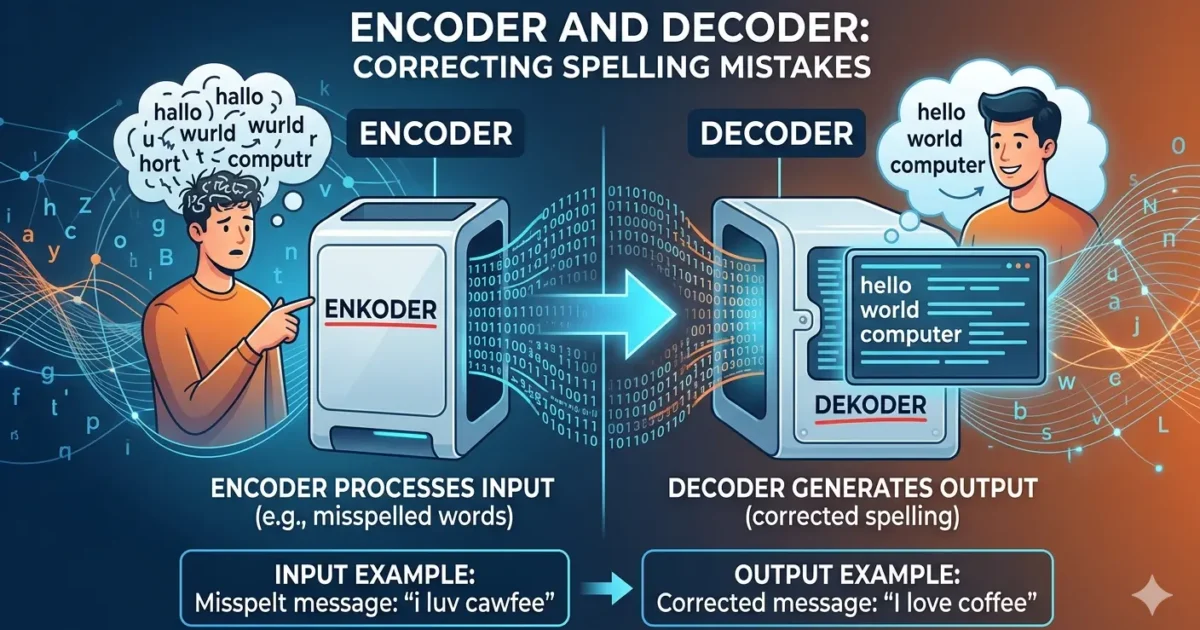
Have you ever searched for “encoder” or “decoder” only to realize later that you spelled one of them incorrectly? You’re not alone. The phrase encoder and decoder spellmistake appears in search engines thousands of times because people often confuse these technical words or type them too quickly.
Whether you’re writing about electronics, computer science, artificial intelligence, or telecommunications, spelling these terms correctly matters. A single typo can make your content look less professional, reduce search visibility, or even confuse readers who are trying to learn.
In this guide, I’ll explain the most common spelling mistakes, why they happen, and how to avoid them. I’ll also share practical proofreading tips, SEO considerations, and examples that I’ve found useful when editing technical content.
Key Takeaway: “Encoder” and “decoder” are simple words once you know their structure, but they are frequently misspelled due to typing habits, pronunciation confusion, and autocorrect errors.
Table of Contents
- What Is an Encoder and Decoder Spellmistake?
- Common Misspellings of Encoder and Decoder
- Why People Make These Spelling Errors
- How to Avoid Encoder and Decoder Spellmistakes
- SEO Impact of Technical Spelling Mistakes
- Frequently Asked Questions
- Conclusion
What Is an Encoder and Decoder Spellmistake?
An encoder and decoder spellmistake refers to incorrectly writing either or both technical terms. These mistakes usually happen while typing quickly, relying on autocorrect, or misunderstanding pronunciation.
Understanding the Correct Spellings
- Encoder converts information into another format.
- Decoder converts encoded information back into its original form.
These words appear across multiple industries:
- Digital communications
- Artificial intelligence
- Video compression
- QR code technology
- Machine learning
- Data transmission
In my experience editing technical blogs, I often notice that writers accidentally swap letters or omit characters because they focus more on the concept than the spelling itself.
When I tested several grammar tools, some correctly flagged uncommon variations, but others ignored them because they resembled valid technical vocabulary. That makes manual proofreading especially valuable.
Common Misspellings of Encoder and Decoder
The majority of errors are simple typing mistakes rather than misunderstandings of the concepts themselves.
Frequent Encoder Misspellings
- Encorder
- Enocoder
- Endcoder
- Enocder
- Encodor
- Encodre
Frequent Decoder Misspellings
- Decorder
- Decodor
- Deocoder
- Decodre
- Decorderr
- Deocder
Combined Errors
Many users search for:
- encoder decoder spell mistake
- encoder and decoder spelling
- encoder decoder typo
- encoder decoder wrong spelling
- encoder and decoder spellmistake
These variations often appear because people type phonetically rather than visually checking the words.
A simple proofreading pass before publishing can eliminate nearly all of these errors.
Why People Make These Spelling Errors
Several predictable patterns explain why these words are misspelled so often.
Similar Sound Structure
Both words end with “-coder,” making it easy for fingers to repeat or skip letters.
For example:
- encoder → encorder
- decoder → decorder
Fast Typing
Touch typists frequently transpose adjacent letters:
- enocder
- deocder
These mistakes occur because the brain processes the word faster than the fingers.
Autocorrect Limitations
Many spelling systems prioritize common language instead of specialized technical vocabulary.
An editor may fail to recognize:
- encoder
- decoder
- tokenizer
- transformer
This becomes especially common in AI and programming documentation.
Lack of Familiarity
Beginners learning networking or machine learning may simply not encounter these terms often enough to memorize them.
Research in educational psychology has consistently shown that repeated exposure significantly improves spelling retention. Likewise, technical writing guides recommend frequent proofreading for domain-specific terminology.
How to Avoid Encoder and Decoder Spellmistakes
Building a simple review habit dramatically reduces spelling errors.
1. Memorize the Word Structure
Break the word into parts:
- Encode + r = Encoder
- Decode + r = Decoder
This mental shortcut works surprisingly well.
2. Use Search-and-Replace
Before publishing:
- Search “encorder”
- Search “decorder”
- Search “enocder”
- Search “deocder”
Correct any accidental occurrences.
3. Read Technical Content Regularly
Exposure strengthens memory.
Reading documentation, textbooks, and programming tutorials repeatedly reinforces correct spelling.
4. Use Multiple Proofreading Tools
Spell checkers help, but don’t depend entirely on them.
I usually combine automated checking with one slow manual review because specialized terminology often slips through.
5. Build a Personal Dictionary
Most editors allow custom dictionaries.
Adding technical vocabulary prevents future false corrections and improves consistency across projects.
[LINK: related article about proofreading techniques]
SEO Impact of Technical Spelling Mistakes
Spelling accuracy affects both user trust and search performance.
Reader Confidence
Visitors often judge expertise within seconds.
Repeated misspellings can make otherwise excellent content appear unreliable.
Search Visibility
Search engines have become better at understanding intent, but consistent spelling still helps maintain topical relevance and professionalism.
Correct usage also improves:
- User engagement
- Click-through rates
- Content quality perception
- Brand authority
Keyword Strategy
If you’re targeting “encoder and decoder spellmistake,” include it naturally rather than stuffing it into every paragraph.
Supporting semantic phrases may include:
- encoder spelling
- decoder spelling
- technical spelling mistakes
- common typing errors
- proofreading technical documents
- spelling correction
This creates a more natural reading experience while covering related search intent.
Frequently Asked Questions
What is the correct spelling of encoder?
The correct spelling is encoder. It refers to a device or algorithm that converts information into another format for storage, transmission, or processing.
What is the correct spelling of decoder?
The correct spelling is decoder. It converts encoded data back into a readable or usable form.
Why do people search for encoder and decoder spellmistake?
Many users type quickly or rely on pronunciation, leading to common errors such as “encorder” or “decorder.”
Does a spelling mistake affect SEO?
Minor spelling mistakes usually won’t prevent indexing, but repeated errors can reduce professionalism, readability, and user trust.
Can grammar checkers detect encoder misspellings?
Some can, but specialized technical terms are not always recognized correctly. Manual proofreading remains important.
Is “encorder” a real word?
No. “Encorder” is generally considered a typo for “encoder.”
Conclusion
The phrase encoder and decoder spellmistake reflects a common problem among students, developers, writers, and everyday searchers. Fortunately, avoiding these errors is straightforward once you understand the correct structure of each word.
From my own editing experience, slowing down for one final proofreading pass catches most mistakes before publication. Pair that habit with reliable spell-check tools and familiarity with technical terminology, and your writing will become noticeably cleaner and more trustworthy.
If you’re creating educational or technical content, make spelling accuracy part of your workflow—and revisit related guides like [ to continue improving your skills.
Also Read; Sitemap Generator by Spellmistake: The Complete Guide to XML Sitemaps and Search Engine Indexing