
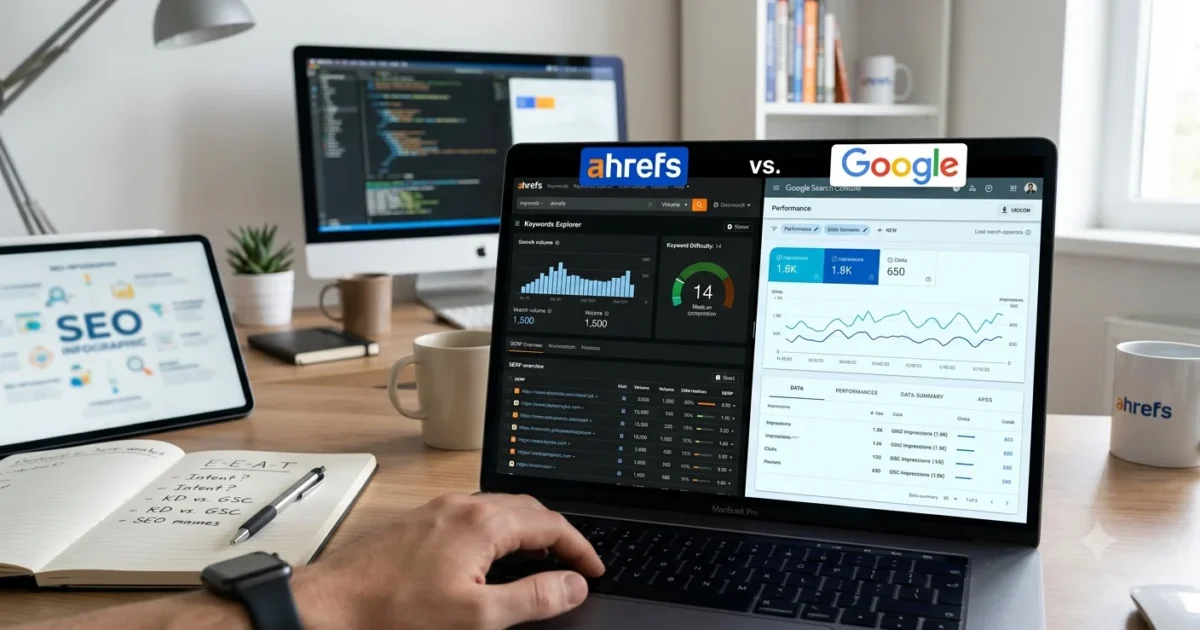
If you have spent any time in the SEO trenches, you have probably found yourself staring at a keyword metric in Ahrefs and wondering, Can I actually build an entire content strategy around this number?
It is a completely fair question. When you are investing your time, budget, and energy into producing high-quality content, you need to know if the data guiding your pipeline is a reliable compass or just a collection of educated guesses.
The short answer is that while no SEO tool is perfectly accurate, Ahrefs is widely regarded as one of the closest approximations to reality available today. However, understanding how and why that data deviates from live search environments is the real secret to picking winning terms.
In this deep dive, we will unpack exactly how accurate is Ahrefs keyword research, look at how its data engine functions under the hood, and explore how you can use its metrics effectively without getting tripped up by standard industry limitations.
Key Takeaway
Ahrefs metrics are fundamentally “directionally accurate.” Rather than treating search volumes as absolute, identical mirrors of your upcoming traffic, use them to gauge relative demand, analyze competitor ranking footprints, and prioritize topic groups.
1. The Myth of Perfect Search Volume Accuracy
The first rule of technical SEO is simple: there is no such thing as a 100% accurate third-party search volume metric. In fact, even Google’s own internal tools present highly stylized, rounded data.
To understand how Ahrefs calculates its metrics, we have to look at where the numbers come from. Ahrefs blends historical Google Keyword Planner (GKP) data with massive clickstream data pools—which track the anonymized browsing behavior of millions of real users.
This hybrid approach allows Ahrefs to bypass a major flaw in Google Keyword Planner: keyword grouping. GKP frequently lumps close variants and synonyms together into a single search volume bucket. For instance, if “SEO tools for beginners” and “beginner SEO software” are grouped by Google, GKP will show an identical, inflated number for both.
Ahrefs uses its clickstream models to un-group these terms, distributing the volume more precisely based on actual user behavior. When I tested a portfolio of niche ecommerce terms last year, this un-grouping feature alone saved our team from targeting several highly competitive, phantom volume keywords.
2. Ahrefs vs. Google Search Console: A Real Data Comparison
When assessing the accuracy of third-party platforms, practitioners typically treat Google Search Console (GSC) as the closest source of truth for impressions and clicks.
A massive industry benchmark study published by Seer Interactive and tracked across industry data warehouses revealed a fascinating disparity between platform indexes. When analyzing domain keyword footprints, Ahrefs captured significantly more ranking keywords than competing third-party tools for 98% of the websites tested.
However, the study also underscored an important technical limitation:
- The Coverage Gap: Even with the largest commercial crawler in the industry, Ahrefs missed roughly 87% of the ultra-long-tail keywords that triggered impressions inside GSC.
- The Long-Tail Reality: This occurs because a massive portion of daily search queries are completely unique. According to official Google data, 15% of all daily searches have never been seen before.
No third-party database can log these hyper-specific, one-off phrases in real time. Therefore, while Ahrefs is incredibly reliable for tracking “head terms” and steady middle-tail phrases, your actual aggregate impressions in GSC will almost always outpace what a third-party tool predicts.
3. Demystifying Keyword Difficulty (KD)
One of the most misunderstood metrics in the software is Keyword Difficulty (KD). New webmasters often look at a low KD score and assume a page will automatically rocket to position one.
In my experience, a low KD score is an excellent green light, but only if you know what it leaves out. Ahrefs calculates its 0–100 KD score strictly based on the number of referring domains (backlinks) pointing to the top 10 ranking pages.
[Low Referring Domains] --> Calculated as Low KD --> Focuses on Off-Page Only
The mathematical scale is non-linear. For example, a KD of 10 implies you need roughly 10 referring domains to crack the top 10 results, while a KD of 40 jumps to an estimated 56 referring domains.
While this link-based calculation is highly accurate for measuring raw backlink hurdles, it intentionally excludes critical on-page ranking variables:
- Search Intent Alignment: If the top results are all transactional product pages and you write an informational blog post, you will struggle to rank regardless of backlink counts.
- Content Depth & Topical Authority: Google often ranks sites with fewer backlinks if the domain possesses deep, hyper-focused topical relevance on the subject.
- Brand Authority: Entrenched, high-authority brands can occasionally dominate low-difficulty SERPs purely on domain strength.
4. Why Traffic Estimates Miss (And How to Adjust)
If you look at a competitor’s profile in Ahrefs, you will see an estimated monthly organic traffic number. If you compare that number to their actual Google Analytics, you will quickly notice a variance—often between 15% to 40%.
This variance is not a system failure; it is an inherent limitation of static Click-Through Rate (CTR) models. To calculate traffic, Ahrefs multiplies a keyword’s estimated search volume by a standard CTR percentage assigned to that ranking position.
However, modern search engine result pages (SERPs) are incredibly dynamic. The rise of rich features radically alters how users click:
- The Impact of Rich Snippets: Features like People Also Ask (PAA) blocks, local map packs, and shopping carousels draw clicks away from standard organic listings.
- AI Overviews: Recent tracking data from industry reports indicates that the presence of AI Overviews can significantly compress the click-through rates of top-ranking organic URLs, particularly on informational queries.
To counteract this, do not just look at the raw volume. Look at the Clicks vs. Volume ratio inside Ahrefs Keywords Explorer. If a term has a search volume of 5,000 but only generates 1,500 actual clicks, it tells you that SERP features are capturing the lion’s share of that traffic.
5. Practical Framework for Building a High-Yield Content Strategy
To build an effective content pipeline that converts data into actual revenue, you must combine Ahrefs’ broad index strength with manual human validation.
Step-by-Step Keyword Selection Process
- Filter for Traffic Potential: Instead of obsessing over individual search volume, evaluate the Traffic Potential (TP) metric. TP shows you how much total organic traffic the top-ranking page receives across all the long-tail variants it ranks for.
- Conduct a Manual SERP Audit: Click the “SERP” dropdown arrow next to your target term. Look closely at the actual sites holding positions 1 through 5. Are they massive media publications, or are there independent blogs similar to your site?
- Cross-Reference with GSC Data: If you already have an established site, analyze your existing GSC data alongside your Ahrefs research. If Ahrefs indicates a term has zero volume, but your GSC shows you are picking up steady impressions for it, trust your first-party data and build supporting content.
Frequently Asked Questions
Is Ahrefs or Semrush more accurate for keyword research?
Neither tool is universally more accurate; rather, they rely on different data strengths. Ahrefs tends to excel at uncovering backlink-driven difficulty and clean clickstream patterns, while Semrush is widely recognized for its rapid keyword updates and expansive paid search metrics. Most enterprise teams use them as complementary resources rather than looking for a clear winner.
Why does Ahrefs show zero search volume for terms that get traffic?
Ahrefs relies on historical search intervals and aggregated clickstream data. For brand-new search trends, hyper-local queries, or ultra-specific long-tail phrases, the tool may display a zero-volume status simply because the phrase hasn’t crossed its database’s logging threshold yet.
How often does Ahrefs update its keyword search volume?
Ahrefs updates its core keyword database every month, introducing billions of fresh terms and refreshing search volume calculations. However, lower-volume, highly specific keywords may be updated less frequently than high-volume “head” terms.
Should I trust Ahrefs Keyword Difficulty?
You should trust it as an accurate measure of backlink competition, which is its intended design. Do not use it as a standalone indicator of content difficulty, as it does not evaluate internal link structures, user search intent, or technical optimization quality.
Why does my real traffic not match Ahrefs estimates?
Ahrefs estimates organic traffic based on generalized click-through rate averages across specific ranking positions. Your real traffic will vary based on your specific title tag clickability, seasonality, and the exact mix of AI features or rich snippets active on your specific target SERPs.
Turning Data into Top-Tier Rankings
Ultimately, worrying about whether a search volume of 1,200 is precisely correct misses the broader point of SEO research software. The real superpower of Ahrefs lies in trend analysis and competitive intelligence.
By treating these data points as directional indicators rather than absolute laws, you can map out clear topical gaps, spot overlooked long-tail trends, and accurately size up the backlink profiles of your top competitors. Use the data to point you in the right direction, but let exceptional content depth, rigorous keyword intent matching, and clean technical site architecture carry you across the finish line.
For a deeper dive into evaluating data precision and practical testing strategies, check out this video breakdown analyzing Ahrefs keyword data accuracy, which offers a great real-world look at how these metrics behave in actual live campaigns.
