
Imagine walking into a massive library containing hundreds of billions of pages, asking for a specific answer, and getting the exact right book handed to you in a fraction of a second. That is precisely what Google does every single day. But how do search engines bridge the gap between a user’s problem and your website’s solution? The answer lies in search terms.
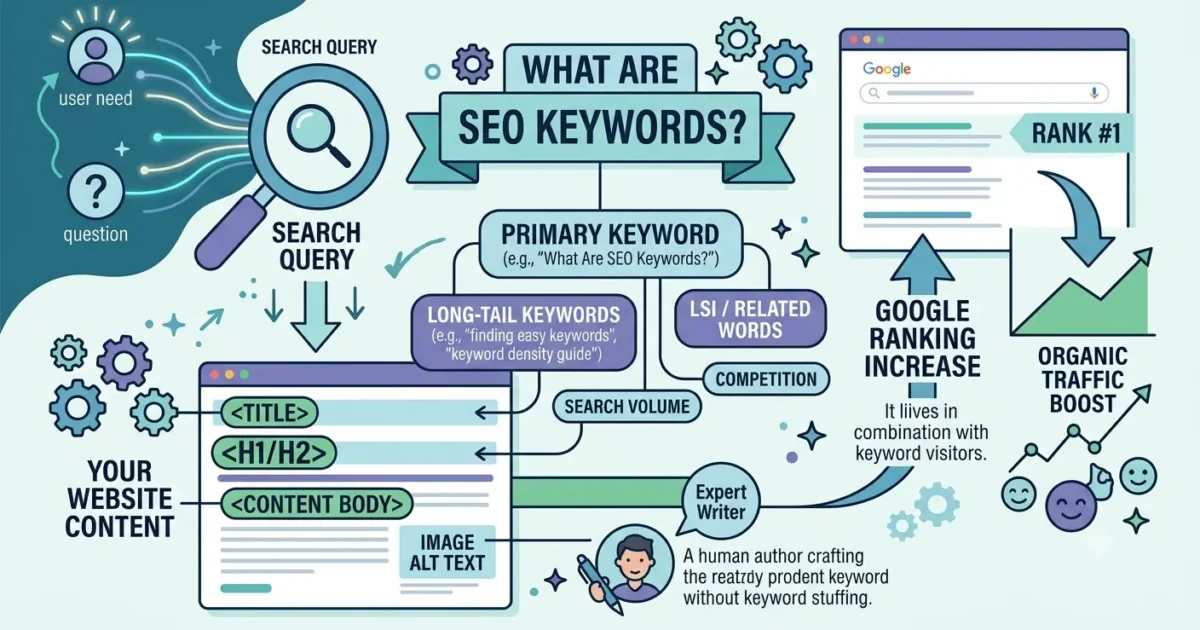
When digital business owners ask me what are seo keywords, I explain that they are the specific words, phrases, and questions that users type into search bars. They act as a foundational pipeline connecting your target audience directly to your web pages.
If you build a website without a deliberate keyword strategy, you are essentially whispering in a crowded stadium. True search visibility requires identifying exactly what your audience is searching for and mapping those phrases to your content structure.
This guide will break down the mechanics of search phrases, explain why they dictate your digital growth, and give you a straightforward blueprint to find the most profitable terms for your brand. Let’s get started.
Key Takeaway: SEO keywords are the core phrases and queries that define what your content is about. They serve as the structural framework search engines use to determine your topic’s relevance to a user’s intent.
Table of Contents
- The Real Value of Keywords in Search Engine Optimization
- The Core Varieties of Search Phrases You Must Know
- How to Decode Search Intent Before Writing Content
- A Step-by-Step Approach to Finding Winning Keywords
- Common Keyword Mistakes That Can Tank Your Rankings
- Frequently Asked Questions
The Real Value of Keywords in Search Engine Optimization {#real-value}
Keywords are far more than just random text labels. They provide direct insight into human behavior, revealing the exact struggles, desires, and questions your market faces.
When you align your content with these phrases, you make it easy for search algorithms to crawl, index, and surface your pages. In my experience, targeting the wrong phrases is the number one reason high-quality web pages fail to get traffic.
A comprehensive data study by Ahrefs revealed a staggering reality: 90.63% of all indexed pages on the internet receive zero organic traffic from Google. The primary driver behind this invisible content? A total lack of keyword research.
When you take the time to research specific search phrases, you ensure that every article you write answers an existing market demand. You stop guessing what people want to read and start building your content strategy around hard data.
The Core Varieties of Search Phrases You Must Know {#core-varieties}
Not all search terms are created equal. To build a balanced strategy, you need to understand how keywords differ based on length, search volume, and competitiveness.
Short-Tail Keywords (Head Terms)
These are broad, single-word or two-word phrases like “marketing” or “running shoes”. While they attract massive monthly search volumes, they are incredibly competitive and highly ambiguous. Ranking for head terms usually requires years of authority building and an enterprise budget.
Long-Tail Keywords
These are highly specific, multi-word phrases or full questions—such as “best lightweight running shoes for flat feet”. According to broader industry studies, long-tail terms make up the vast majority of all search queries online. They offer lower individual search volume but carry two massive advantages:
- They are significantly easier to rank for due to lower competition.
- They attract highly qualified visitors who are much closer to making a conversion decision.
LSI and Semantic Keywords
Latent Semantic Indexing (LSI) terms are conceptually related phrases that search algorithms look for to understand the context of a page. For example, if your primary keyword is “apple,” Google looks for secondary words like “juice,” “orchard,” or “recipe” to ensure you aren’t talking about smartphones.
How to Decode Search Intent Before Writing Content {#search-intent}
Years ago, you could rank a page simply by repeating a keyword dozens of times. When I tested a classic keyword-stuffing model against a user-focused content model, the stuffed page completely dropped off the SERPs within weeks. Modern search optimization prioritizes user satisfaction above all else.
To satisfy Google’s ranking algorithms, your content must match the precise search intent behind the query—the underlying goal of the user. Search intent generally falls into four main categories:
- Informational: The user is seeking knowledge (e.g., “how to fix a leaky faucet”).
- Navigational: The user wants to find a specific website or brand page (e.g., “Facebook login”).
- Commercial: The user is researching options before buying (e.g., “Ahrefs vs Semrush review”).
- Transactional: The user is ready to make an immediate purchase (e.g., “buy iPhone 16 online”).
Before writing a single sentence, type your target phrase into Google and look at the top three results. If the first page is filled with product checkout pages, an informational blog post will not rank there, regardless of how well it is written.
A Step-by-Step Approach to Finding Winning Keywords {#finding-keywords}
Finding the sweet spot between high search demand and manageable competition requires a structured approach. Follow these steps to build your seed list:
Step 1: Brainstorm Seed Topics
Start by listing the broad topics relevant to your business. If you run an online fitness coaching service, your seed categories might include “weight loss tips,” “strength training,” or “meal prepping.”
Step 2: Utilize Specialized Software
Plug your seed topics into professional search tools like Ahrefs Keywords Explorer or Semrush. These platforms generate thousands of variations and provide critical performance metrics:
- Search Volume: An estimate of how many times the phrase is searched per month.
- Keyword Difficulty (KD): A score from 0 to 100 indicating how hard it will be to outrank the current competition.
Step 3: Analyze Competitor Gaps
Identify websites of a similar size to yours that are already ranking well. Look at the phrases driving traffic to their top pages to find quick-win opportunities your own content strategy might be missing.
Common Keyword Mistakes That Can Tank Your Rankings {#common-mistakes}
Avoiding technical errors during content optimization is just as critical as finding the right phrases. Keep these major pitfalls in mind as you build out your web pages:
| Mistake Type | The Negative Impact | The Correct Approach |
| Keyword Stuffing | Triggers automated search spam filters and creates unreadable copy. | Keep primary keyword density between 1–1.5% and write for humans. |
| Keyword Cannibalization | Forces multiple pages on your own site to compete against each other. | Dedicate one unique primary keyword to each individual URL. |
| Ignoring Search Intent | High bounce rates because users don’t find what they expect. | Analyze the top-ranking SERP results before structuring your page. |
Be fully transparent with your audience. Never use misleading terms or sensationalized formatting just to trick someone into clicking your link. True authority is built on accurate, high-quality information that directly delivers on its promises.
Frequently Asked Questions {#faq}
What are SEO keywords in simple terms?
SEO keywords are the specific search terms, questions, and phrases that internet users type into search engines like Google. Content creators use these phrases strategically in their text so search systems can match their web pages with relevant user queries.
How many keywords should I focus on per page?
You should target one main primary keyword per page to give it a clear, hyper-focused topic. Alongside your primary term, you can naturally integrate three to five secondary or long-tail variations that support the overarching subject.
Is keyword stuffing still penalized by Google?
Yes, modern search ranking systems are highly sophisticated and heavily penalize over-optimization or artificial keyword stuffing. Repeating search terms unnaturally compromises user experience, which directly damages your organic visibility.
How do I naturally find LSI or semantic keywords?
The easiest way is to look at the “People Also Ask” and “Related Searches” sections at the bottom of a Google search results page. These sections show you the exact variations, synonyms, and sub-topics that Google automatically associates with your main phrase.
What is keyword difficulty (KD)?
Keyword difficulty is a third-party SEO metric scored from 0 to 100 that estimates how challenging it will be to rank on the first page of search results for a specific phrase. This score is primarily calculated based on the strength and quantity of backlinks held by the top-ranking pages.
Conclusion
Mastering what are seo keywords and how to deploy them safely is the cornerstone of any sustainable digital marketing strategy. They are not about manipulating a computer program or finding a temporary shortcut. Instead, keywords provide an explicit blueprint of what your potential clients need help solving.
By finding the right long-tail phrases, matching user search intent, and creating helpful content that highlights real experience, you can steadily climb the search rankings and earn long-term organic traffic.
Take action today. Pick one existing blog post or landing page on your website, check its primary search term in a free keyword generator tool, and update the text to make sure it answers the exact questions your audience is asking online.
Also Read; What’s SEO? A Simple Guide to Search Optimization
