
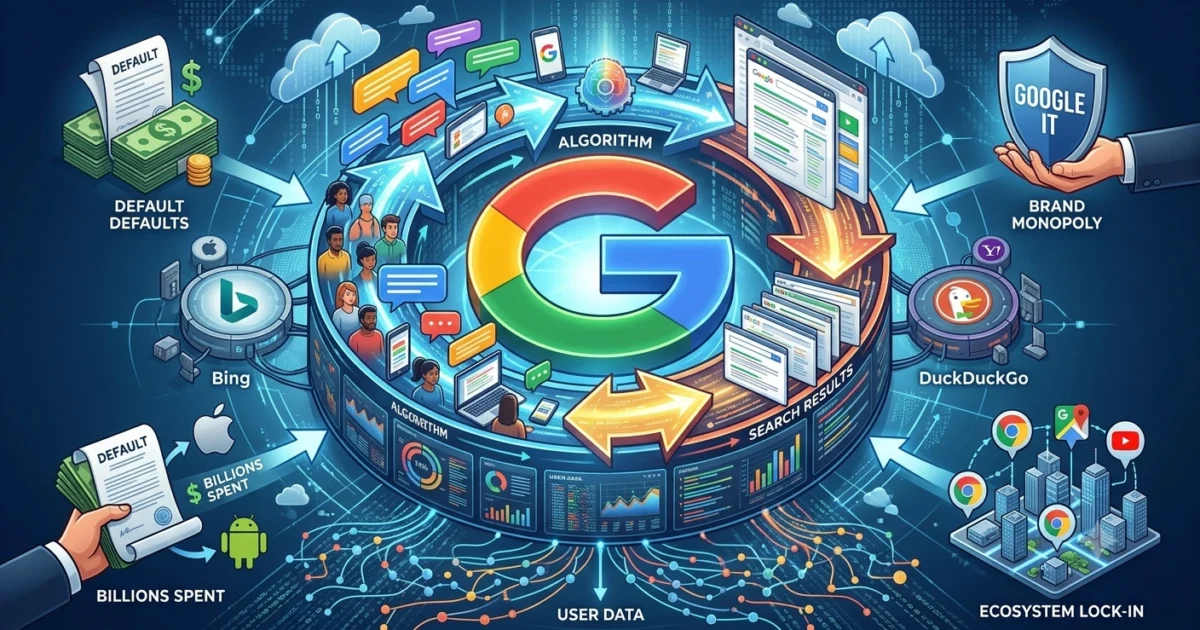
Ever wonder why we say “Google it” instead of “search it”? It’s because a single company handles over 90% of all internet searches worldwide. For over two decades, competitors have tried to chip away at this monopoly, yet Google’s grip on our digital habits only seems to tighten.
Understanding why does Google dominate search engine landscapes isn’t just trivia—it is a survival guide for modern businesses. In my years tracking search algorithms, I’ve watched minor updates completely rewrite the rules of online visibility. If you rely on digital traffic, you need to understand the massive machinery driving the web’s gatekeeper.
This article will break down the precise technical, financial, and psychological reasons behind Google’s relentless market dominance, and what it means for the future of the web.
Key Takeaway: Google’s dominance isn’t just about having a better algorithm anymore; it’s sustained by an unbreakable ecosystem of data loops, massive default distribution deals, and deep consumer habits.
Table of Contents
- The Tech Evolution: From PageRank to AI Powerhouses
- The Data Loop: Why More Data Equals Better Results
- The Default Strategy: Apple, Android, and the Billions Spent
- The Brand Monopoly: How a Noun Became a Verb
- The Ecosystem Lock-In: Chrome, Maps, and YouTube
- Frequently Asked Questions
- The Future of Search
1. The Tech Evolution: From PageRank to AI Powerhouses
In the late 1990s, search engines like Yahoo and AltaVista were messy directories. They ranked pages based on how many times a keyword appeared on a page. Google changed everything by introducing the PageRank algorithm, which treated links like votes of confidence.
When I tested early search alternatives in the 2000s, the difference was night and day. Google understood intent, while others just matched words. Over the years, they shifted from rigid keyword matching to advanced machine learning systems like RankBrain, BERT, and modern generative AI models.
These updates allow Google to understand the context of conversational queries. For example, if you search for “can you catch a bird without a cage,” Google knows you are looking for humane trapping methods, not a store selling birdcages. This relentless focus on user intent keeps the core product lightyears ahead of basic search infrastructure.
2. The Data Loop: Why More Data Equals Better Results
Google’s biggest advantage is a flywheel effect: more users generate more data, which creates a better algorithm, which attracts more users. Every click, scroll, and abandoned search query trains their system.
According to research from the International Journal of Research in Marketing, data scale creates a nearly insurmountable barrier to entry in tech markets. When someone clicks the third result instead of the first, Google learns instantly that the third result was more relevant for that specific phrase.
[More Users] ➔ [More Click & Search Data] ➔ [Finer Algorithm Tuning] ➔ [Better Search Results] ➔ (Back to More Users)
Competitors like DuckDuckGo or Mojeek simply don’t have the query volume to train their systems at this level. In my experience auditing search traffic, alternative search engines often lag behind on breaking news or highly localized queries because they lack the real-time user signals that Google processes by the millisecond.
3. The Default Strategy: Apple, Android, and the Billions Spent
Google doesn’t just rely on people actively choosing its website; it buys its way onto your devices. The company pays billions of dollars annually to remain the default search engine on Safari, Firefox, and major mobile carriers.
During recent antitrust investigations, court documents revealed that Google pays Apple upwards of $20 billion a year just to be the default option on iPhones.
- The Power of Defaults: Most consumers never change their out-of-the-box settings.
- Android Dominance: Google owns the Android operating system, ensuring its suite of apps comes pre-installed on billions of devices globally.
- The Cost Barrier: Micro-competitors cannot afford these multi-billion-dollar distribution fees, effectively locking them out of mobile real estate.
This strategy ensures that even if a competitor builds a slightly better search tool, the vast majority of casual internet users will never encounter it.
4. The Brand Monopoly: How a Noun Became a Verb
Psychology plays a massive role in market control. Google achieved the ultimate marketing milestone when its brand name became a universal verb for seeking information.
“Google it” is ingrained in global culture.
This psychological capture means consumers don’t think “where should I search for this?” They simply open a browser and type. To break this habit, a competitor cannot just be equal to Google; it has to be ten times better to convince a user to break a twenty-year-old habit.
5. The Ecosystem Lock-In: Chrome, Maps, and YouTube
Search isn’t a standalone product; it’s the anchor of a massive, interconnected ecosystem. Google tracks user behavior across a web of highly popular services:
| Platform | Role in Search Dominance |
| Google Chrome | The world’s most popular browser directly routes the omnibox (address bar) to Google search. |
| Google Maps | Captures nearly all local intent searches (“restaurants near me”), bypassing traditional web results. |
| YouTube | The second largest search engine in the world feed video content directly back into Google SERPs. |
Because these platforms share data, Google knows your location, your video preferences, and your browsing history via Chrome. This allows them to personalize search results with unmatched accuracy. If you search for “football,” Google knows whether you mean soccer or American football based entirely on your past interactions within its ecosystem.
Frequently Asked Questions
Why does Google dominate search engine markets compared to Bing?
Google dominates because it has a decades-long head start in data collection and machine learning. Additionally, Google’s massive distribution deals—like paying billions to be Apple’s default search provider—prevent Bing from gaining significant mobile market share, despite Microsoft embedding Bing into Windows.
Is Google’s search monopoly legal?
Regulatory bodies globally, including the US Department of Justice and the European Commission, have challenged Google’s practices. While Google argues its success is due to a superior product that users choose, regulators argue that massive default-placement payments illegally block competition.
How much market share does Google search have?
Google consistently controls between 90% and 94% of the global search engine market share across desktop and mobile devices. Bing sits in a distant second place, usually hovering around 3% to 4%.
Can any search engine beat Google?
An alternative search engine is unlikely to beat Google using traditional text-and-link search. However, shifts toward localized AI assistants, social commerce search (like TikTok), or decentralized Web3 platforms could eventually chip away at Google’s core traffic over the next decade.
The Future of Search
The reason why does Google dominate search engine markets boils down to a perfect blend of superior technology, psychological branding, and aggressive ecosystem integration. They built a better tool early on, used that success to capture consumer data, and reinvested their billions to secure every digital entry point on earth.
For creators and businesses, this means optimization strategies must respect Google’s evolving guidelines—particularly their focus on real, human expertise. If you want to keep your traffic safe from future algorithm shifts, your next step should be auditing your content for deep, original value.
Also Read; How Accurate Is Ahrefs Keyword Research? What the Data Shows
